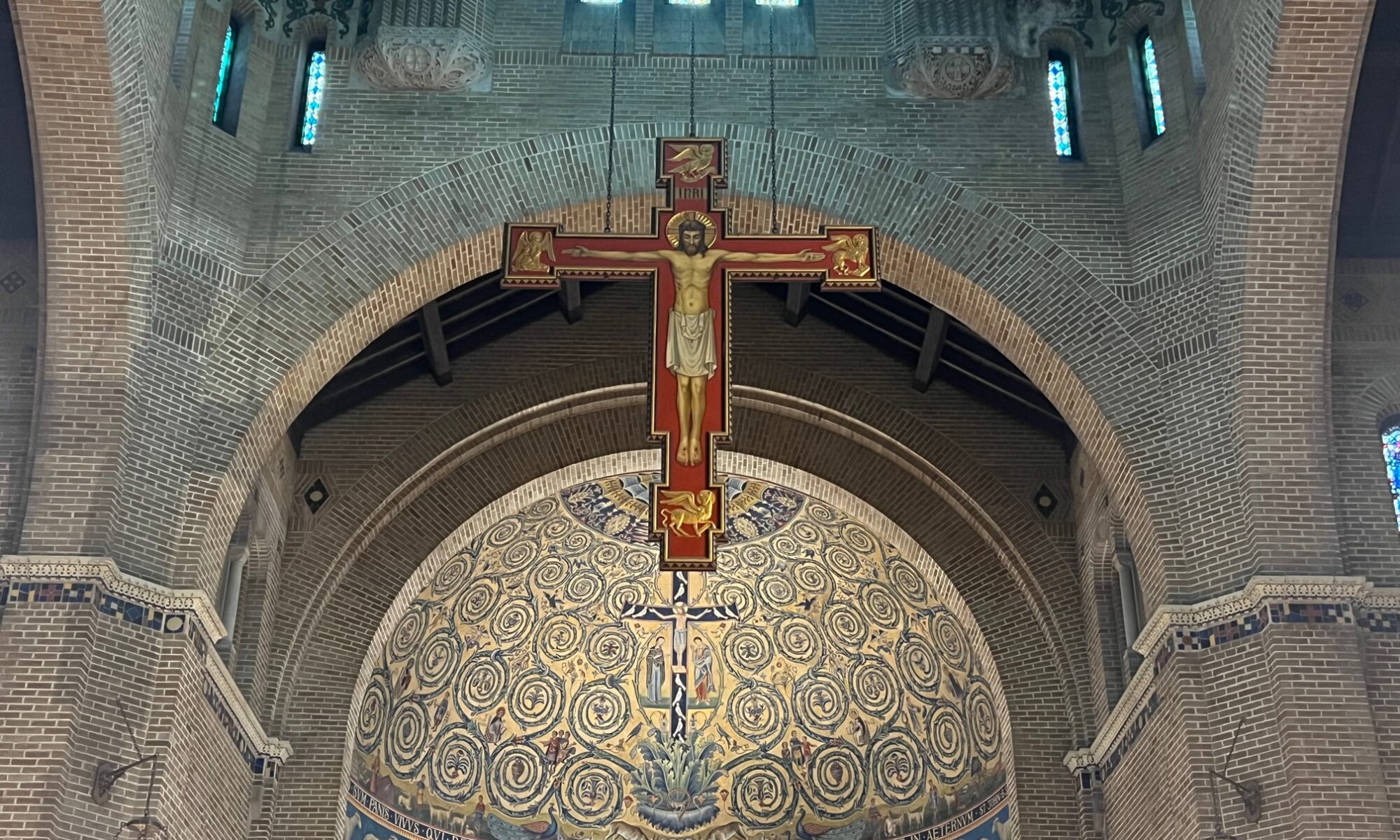
In God’s salvation plan, our Lord Jesus Christ is the perfect sacrifice, not only because he is the lamb without blemish, but because He is, in this sacrifice, at the same time: high priest, sacrifice and altar (Rite of Dedication of a Church and an Altar).
During mass, the altar is the symbol of Christ himself, present in the midst of the assembly of his faithful, both as the victim offered for our reconciliation and as heavenly food given to us (CCC 1383). The altar is given the most prominent place in the church, occupying the place that is truly the center towards which the attention of the entire congregation of the faithful naturally converges (GIRM 299).
This is also why the laws of the Church strongly encourages the altar to be fixed to the ground to indicate the Christ eternity and never-ending commitment to his people. Furthermore, at the very least its mensa is to be made of stone echoing the scriptures which repeatedly call Christ a rock and cornerstone (1 Peter 2:4, 1 Corinthians 10:4, Ephesians 2:20).
When an altar is dedicated, it is anointed and incensed. These liturgical actions reveal the sacramental reality of the altar as a sacrament of Jesus Christ. During the dedication prayer, the altar is anointed with the sacred chrism precisely because Jesus Christ is the One Anointed by the Father with the Holy Spirit, making him “High Priest, who, on the altar of His body, offers the sacrifice of His life for the salvation of all” (RDCA). The sacred chrism, the same that we receive at our baptism and confirmation, and that with which the head of the consecrated bishop is anointed, is poured over the five crosses that adorn the altar table, crosses that represent the five wounds of our Lord Jesus Christ, and it is spread over the entire surface of the mensa by the consecrating bishop. Additionally, incense is burned during the dedication of the altar to signify that the perfect sacrifice of Jesus Christ ascends to God the Father as an odor of sweetness.
The altar is the table of sacrifice and at the same time the table of the paschal banquet, on which Jesus Christ offers himself as the new sacrificial lamb. The altar is not only the fulfillment of the paschal table on the last supper, but also prefigures the table of the heavenly banquet, that banquet in which we will celebrate total reunification with God and all of his creation.
Let us show due respect to the altar during the celebration of mass, since it is not only the table of the paschal banquet but also the representation of Jesus Christ who, as High Priest, on the altar of His body, offered the sacrifice of His life for the salvation of all of us.
McNamara, Denis. “Altar as Alter Christus: Ontology and Sacramentality” Adoremus, 18 June 2016, https://adoremus.org/2016/06/altar-alter-christus-ontology-sacramentality