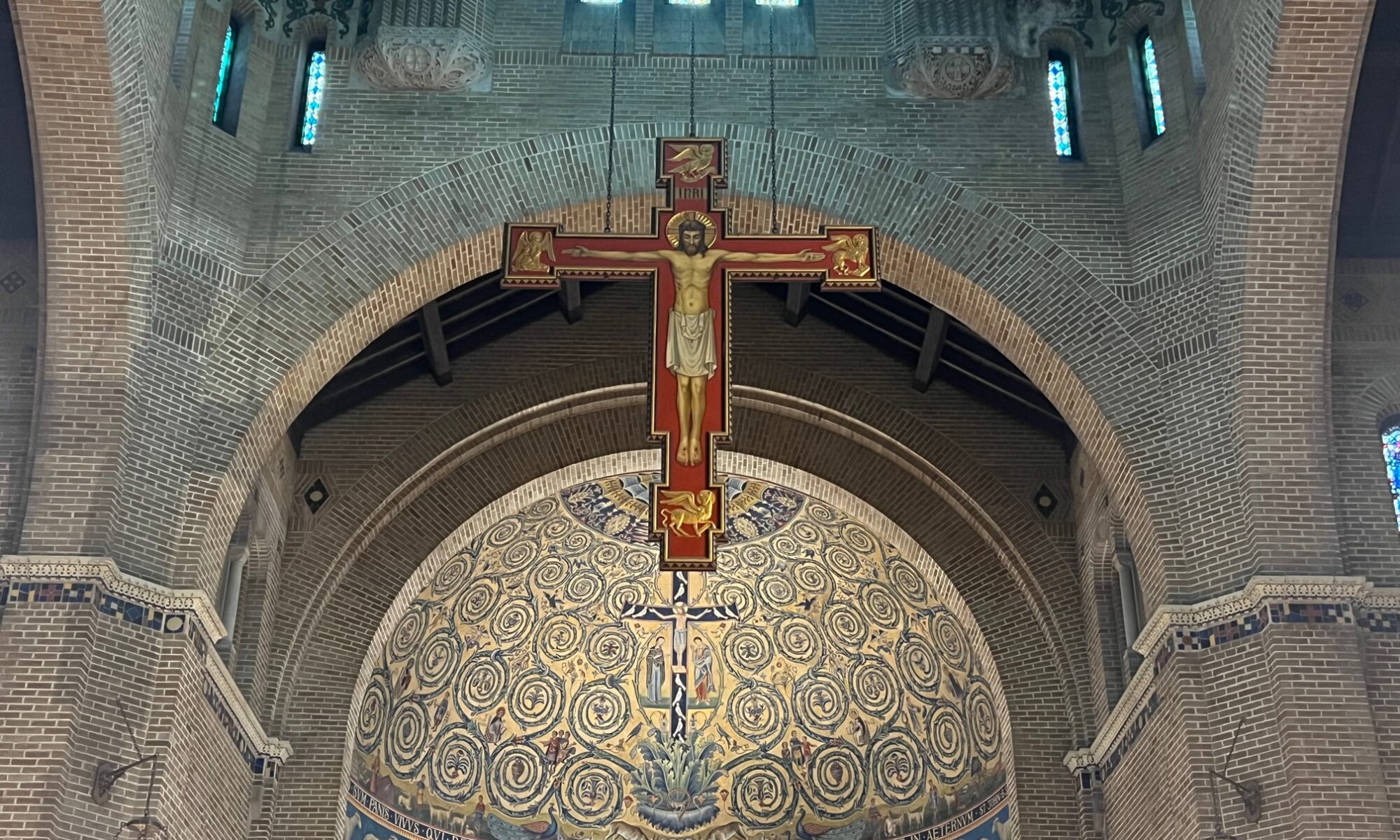
Within the Eucharistic Prayer, after the words of consecration comes the memorial in the Eucharistic Prayers: “Therefore, Father, as we now celebrate the memorial of the saving passion of your Son, of his wonderful resurrection and ascension into heaven.”
Christians, East and West, daily obey Christ’s last will in the Eucharist, “Do this in memory of me” (Luke 22:19). This was the command that the Lord gave us clearly at the Last Supper, that is, “on the eve of his passion, the night on which he was to be betrayed.” And we can fulfill that command, many centuries apart and in many places, precisely because the priesthood of Christ is eternal and heavenly (Hebrews 4:14; 8:1).
Remembrance is the word that ideally links the Eucharist to the Jewish Passover, which was also “a memorial” (Exodus 12:14). It is of such importance that St. Paul, in the account of the institution, repeats twice that command of Jesus; and it further specifies the content of the remembrance to be made of Jesus, saying: “For whenever you eat of this bread and drink of the cup, you proclaim the death of the Lord” (1 Corinthians 11:26). The content of this memorial is the death of Christ.
The memorial of the Eucharist is not a mere remembrance of past realities, of events that occurred centuries ago, but it is a “re-presentation”, that is, to make present here and now, in a sacramental and real way, the same mystery that is celebrated: the Paschal Mystery of Christ, his death and resurrection.
In this way the Eucharist remains in the Church as an ever-living heart, which with its beating brings to the whole Mystical Body the life-giving grace which is the blood of Christ, the eternal priest. In fact, “the work of our redemption is accomplished whenever the sacrifice of the cross is celebrated on the altar, through which ‘Christ, our Passover, has been slain’ (1 Corinthians 5:7)” (LG 3).
In a theological sense, the memorial consists in remembering Jesus to the Father, inviting the Father to remember all that Jesus has done for us, and out of his love, to forgive us and to help us. In the Old Testament, in the moments of greatest trial, one would turn to God and exclaim, “Remember Abraham our father, remember Isaac and Jacob” (Exodus 32:13). But now we, the People of the New Covenant, can raise to God a cry infinitely more powerful than this; we can say to him, “Remember Jesus Christ your Son and his sacrifice!”
The Church remembers (anamnesis) these facts, and in this way, thanks to the liturgical action of Christ the Priest, actualizes them, makes them present and active with all their salvific power in our midst.
In this way, every person can experience a personal encounter with the work of salvation that Christ has accomplished. Christ offers it to him personally. Each one must welcome and live that mystery which is part of his own life, allowing himself to be saved by Christ, accepting the communion in his divine life that he offers us. Every man must give his “yes” to Christ’s love in every personal encounter with Him in the Eucharist.
López, Félix “Explanation of the Mass: The Memorial”, Home of the Mother, Accessed 29 April 2024, https://www.homeofthemother.org/en/resources/eucharist/549-explanation-of-the-mass/2305-memorial