What is the importance of the altar during the mass?

In God’s salvation plan, our Lord Jesus Christ is the perfect sacrifice, not only because he is the lamb without blemish, but because He is, in this sacrifice, at the same time: high priest, sacrifice and altar (Rite of Dedication of a Church and an Altar).

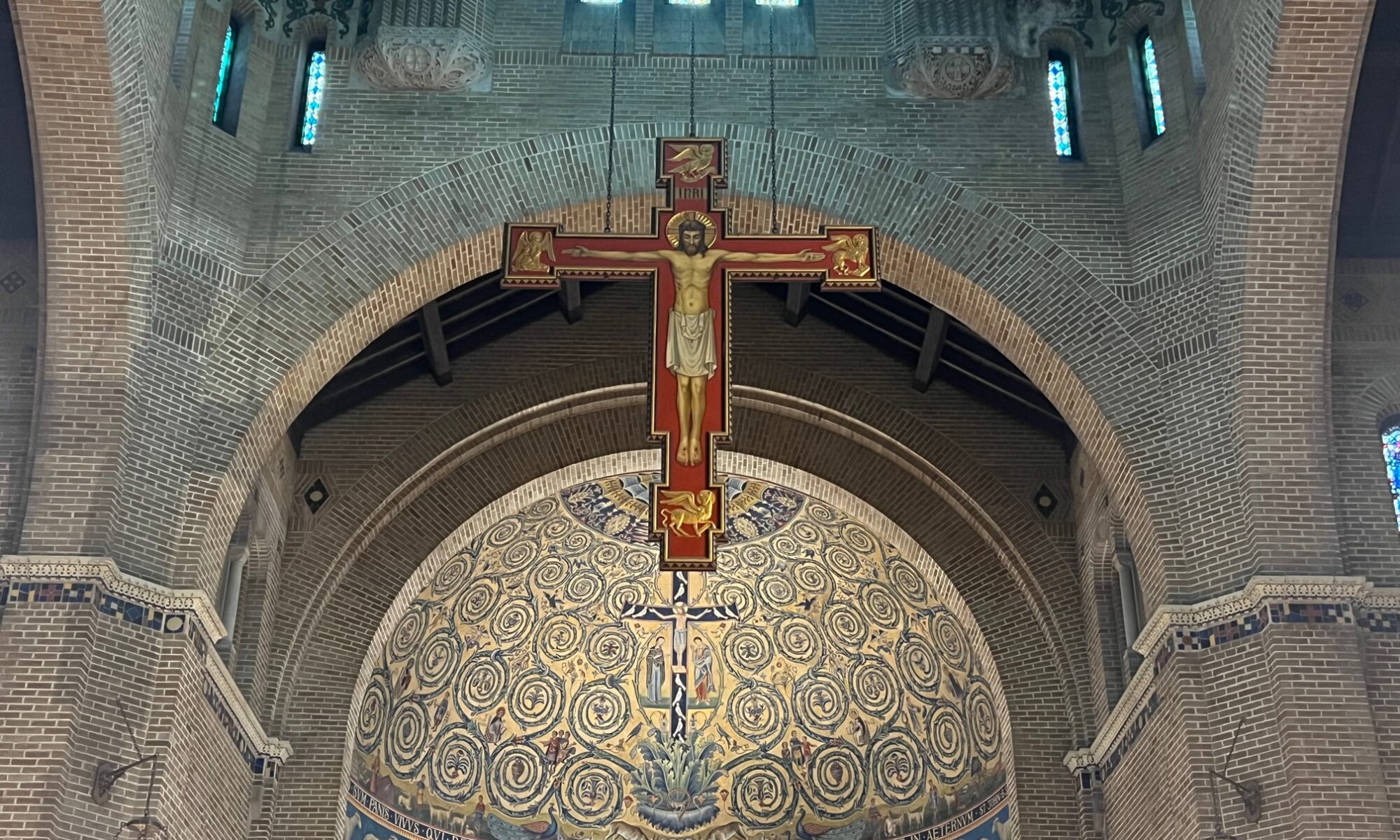
During mass, the altar is the symbol of Christ himself, present in the midst of the assembly of his faithful, both as the victim offered for our reconciliation and as heavenly food given to us (CCC 1383). The altar is given the most prominent place in the church, occupying the place that is truly the center towards which the attention of the entire congregation of the faithful naturally converges (GIRM 299).

This is also why the laws of the Church strongly encourages the altar to be fixed to the ground to indicate the Christ eternity and never-ending commitment to his people. Furthermore, at the very least its mensa is to be made of stone echoing the scriptures which repeatedly call Christ a rock and cornerstone (1 Peter 2:4, 1 Corinthians 10:4, Ephesians 2:20).

When an altar is dedicated, it is anointed and incensed. These liturgical actions reveal the sacramental reality of the altar as a sacrament of Jesus Christ. During the dedication prayer, the altar is anointed with the sacred chrism precisely because Jesus Christ is the One Anointed by the Father with the Holy Spirit, making him “High Priest, who, on the altar of His body, offers the sacrifice of His life for the salvation of all” (RDCA). The sacred chrism, the same that we receive at our baptism and confirmation, and that with which the head of the consecrated bishop is anointed, is poured over the five crosses that adorn the altar table, crosses that represent the five wounds of our Lord Jesus Christ, and it is spread over the entire surface of the mensa by the consecrating bishop. Additionally, incense is burned during the dedication of the altar to signify that the perfect sacrifice of Jesus Christ ascends to God the Father as an odor of sweetness.

The altar is the table of sacrifice and at the same time the table of the paschal banquet, on which Jesus Christ offers himself as the new sacrificial lamb. The altar is not only the fulfillment of the paschal table on the last supper, but also prefigures the table of the heavenly banquet, that banquet in which we will celebrate total reunification with God and all of his creation.

Let us show due respect to the altar during the celebration of mass, since it is not only the table of the paschal banquet but also the representation of Jesus Christ who, as High Priest, on the altar of His body, offered the sacrifice of His life for the salvation of all of us.


McNamara, Denis. “Altar as Alter Christus: Ontology and Sacramentality” Adoremus, 18 June 2016, https://adoremus.org/2016/06/altar-alter-christus-ontology-sacramentality

Who exercises authority over the local Church?

Our Lord Jesus Christ first entrusted to Peter the foundation and authority over the Church (Matthew 16:18-19) and then extends this authority over the Church to the Apostles (Matthew 18:18); after his resurrection, He breathes on them the Holy Spirit (John 20: 22-23), gives them the mission of promulgating the good news (Mark 16:15) and reiterates Peter’s role as leader of the Church. (John 21:15-17).

When we pray the Creed, we declare that the Church is “One, Holy, Catholic and Apostolic”, is in this last declaration of faith that we recognize the apostolic succession from the apostles to the bishops. (Acts 1:21-26)

Peter and his successors are the base or foundation of the Church and in turn its highest authority on earth. It is the Pope, in whom remains the function that the Lord uniquely entrusted to Peter, head of the College of Bishops, Vicar of Christ and Pastor of the universal Church on earth (Canon 331).

Likewise, the Bishops as successors of the Apostles, whom by virtue of the Holy Spirit, are constituted as pastors in the Church so that they too may be teachers of the doctrine. Through episcopal consecration, along with the function of sanctifying, Bishops also receive the functions of teaching and governing, which, however, by their very nature, can only be exercised in hierarchical communion with the head and with the members of the College of Bishops (Canon 375).

It is in the episcopal consecration, in which the presbyter elevated to bishop receives the fullness of the priesthood; he is anointed with the sacred oil, being this spilled over his head so that the Holy Spirit pours his gifts on him and illuminates his decisions.

It is the bishop who is entrusted with the care of the local church or diocese, and it is he who occupies the center of the local Church, and, aided by his Presbytery, has the highest authority in matters of teaching, sanctification and government; he also has responsibility for the pastoral care of the diocese, and is also known as the ordinary bishop or diocesan bishop.

All the Catholic faithful are bound to follow with Christian obedience, everything that the bishops, inasmuch as they represent Christ, declare as teachers of the faith or establish as rulers of the Church (Canon 212).

Let us continue in prayer for the well-being of the Holy Father and our ordinary Bishop, that the Holy Spirit continue to pour out on them and always enlighten them.

How important is the celebration of Pentecost for Catholics?

Fifty days after Good Friday, the Catholic Church celebrates Pentecost Sunday. Where does this celebration come from and how important is it for us Catholics? To find the origins of Pentecost we must go back to the day when the Exodus of the Jews from Egypt finally took place, specifically on Passover day, since it was the next day that Pharaoh finally allowed them to leave Egypt, after traveling through the desert for seven weeks, Moses climbs Mount Sinai and receives the ten commandments (Exodus 20:1-17), these two dates are still important for our older brothers in faith, the Jewish people.

That is why on that day of Pentecost there were gathered in Jerusalem many Jews and converts to Judaism whose regular language was not Hebrew or Aramaic, since they had been born outside the kingdom of Judah, since this was one of the Jewish religious festivals that required pilgrimage to Jerusalem.

It is on this date, and just as Jesus Christ had announced to His disciples (John 14:15-17), it happened that while they were meeting in secret for fear of the authorities, the Holy Spirit enters the house where they were and fills it completely, all the disciples were then filled with the Holy Spirit and went out to proclaim the good news, the Gospel, to everyone; and all who heard them, heard them in their own languages (Acts 2:1-11).

The reception of the Holy Spirit by the disciples and the revelation of the Gospel to all peoples marks the birth of the Universal Church: the Catholic Church. The disciples received the gifts and fruits of the Holy Spirit just as we received them through the Sacrament of Confirmation, and it is by using these gifts that they can communicate the good news to all who are willing to listen, just as it is our mission to take the Gospel to those around us.

Let us cultivate the gifts and fruits of the Holy Spirit strengthened in us through the Sacrament of Confirmation, in which we are sealed to be living witnesses of Jesus Christ.

What is the importance of the Ascension of the Lord in God’s salvation plan?

Forty days after Resurrection Sunday, the Catholic Church celebrates the day of the Ascension of the Lord, when our Lord Jesus Christ returns to the Kingdom of Heaven. This event marks the transition between the glory of the risen Christ and that of the exalted Christ at the right hand of the Father. It also opens the possibility for humanity to enter the Kingdom of God as Jesus announced so many times.

The Ascension of Christ is also the starting point to begin to bear witness to the exalted Christ who returned to the Father to sit at His right. The glorified Lord continues to be present in the world through his action in those who believe in his Word and allow the Spirit to act within them. Jesus’ mandate is clear and current: “Go into all the world and preach the gospel to all creation” (Mark 16:15).

This is how through the events of the Old Testament the nature of God the Father is revealed to humanity in a certain way, it is during the walk of our Lord Jesus Christ on Earth that the nature of God the Son is revealed to us, being His Ascension to the heavens necessary for the nature of God the Holy Spirit to be revealed later on the day of Pentecost (Acts 2:1-4).

Having the Way, the Truth, and the Life been revealed to us (John 14:6), now we are to seek to be holy as our Father who is in Heaven is holy (Matthew 5:47-48).

Let us cultivate the gifts and fruits of the Holy Spirit to reach the Kingdom of Heaven that has been opened for us thanks to the death and resurrection of our Lord Jesus Christ, so that all who believe in Him do not wander in darkness, but live in the Eternal Glory of God.

As a Catholic, how should I show respect for the temple, including the altar and the tabernacle, and why is it important to do so?

The temple is a sacred place where we can encounter God in a special way. Therefore, as Catholics, we must treat the temple with respect and consideration. The altar and the tabernacle are two places of great importance in the temple that require a particularly reverent attitude from us.

In the Catholic Church, the altar is the place where the Eucharist is celebrated, which is the central sacrament of our faith. Therefore, when approaching the altar, we must do so with respect and consideration. In the Code of Canon Law, it is established that the altar, at which the Sacrifice of the Cross is made present under sacramental signs, is also the table of the Lord on which the People of God are gathered to participate in the Eucharist (GIRM 296).

That is why, when approaching the altar, a bow or reverence is made, which is a demonstration of respect and adoration to God, who is present in a special way in the sacrament of the Eucharist. As Psalm 138:2 says: “I will bow down toward your holy temple and will praise your name for your unfailing love and your faithfulness”.

On the other hand, the tabernacle is the place where the Blessed Sacrament is kept after Mass so that the faithful can visit and pray before it at any time. It is a place of prayer and adoration, and as such, we must show respect when approaching it. The Catholic Church teaches that the Blessed Sacrament is the body and blood of Christ, and that is why we must make a genuflection when approaching it. This is a demonstration of our faith in the real presence of Jesus in the Blessed Sacrament.

In the Catechism of the Catholic Church, we are reminded that the tabernacle was first a tent, or a portable sanctuary, which served as a movable sanctuary during the Exodus. Today the true ‘sanctuary’ of the New Testament is Christ Himself. That is why our attitude when approaching the tabernacle must be one of respect and adoration, because it is there that the presence of Christ in the Blessed Sacrament is found.

In summary, as Catholics, we must treat the temple with respect and consideration, and demonstrate our reverence and adoration when approaching the altar and the tabernacle. The bow or reverence to the altar and the genuflection to the Blessed Sacrament in the tabernacle are expressions of our faith in the real presence of Christ in the Eucharist and in the Blessed Sacrament. Let us remember the words of Psalm 29:2 “Ascribe to the Lord the glory due his name; worship the Lord in the splendor of his holiness.

What is a plenary indulgence?

During certain festivals and occasions, the Church offers the faithful what are known as plenary indulgences, but what are plenary indulgences? To understand the concept, we first have to understand the concept of penance, let’s imagine a freshly cut wood, smooth on all sides, this is how our soul is after receiving baptism, now let’s imagine nails on said board, the nails represent each sin we have committed, with the sacrament of reconciliation, these nails are removed from the board, but the wood now has holes and the  occasional splinter, it is no longer smooth, it is through penance that we fill those holes and sand the board again to make it smooth again, this implies effort and dedication. This process can be compared to penance. In order for our soul to be clean again as it was after our baptism, we must not only confess our sins but also comply with penance, this penance is paid in two ways: with suffering and good works in this life or with a time in purgatory.

The Catholic Church, under the authority that Jesus Christ himself granted it (Matthew 18:18), establishes that plenary indulgence is the remission before God of the temporal penalty for sins, already forgiven, in terms of guilt, that a The willing faithful obtain through the mediation of the Church (CCC 1471), that is, the plenary indulgence is in charge of correcting the penalties of those sins that we have confessed up to that moment. A plenary indulgence can be obtained to also remedy the sorrows of a deceased person, so that his soul can be admitted to the Kingdom of Heaven.

How can we obtain a plenary indulgence? There are ways to obtain a plenary indulgence at any time: adore the Blessed Sacrament for half an hour, pray a Stations of the Cross, pray the rosary as a family or in community, read the Bible for half an hour, you can also obtain a plenary indulgence on special occasions, such as: Saying an Our Father and a Creed in a sanctuary or basilica, Receiving the Urbi et Orbi blessing, doing three-day spiritual exercises, Saying a “Te Deum” on December 31 or a “Veni Creator” on January 1 in a church, Pray a “Look at me, O my beloved and good Jesus” before a crucifix any Friday of Lent after communion, pray a “Tantum ergo” on Holy Thursday before the Blessed Sacrament after the services, attend the services on Good Friday, renewing baptismal promises at the Easter Vigil, praying the “Veni Creator” in a church on the day of Pentecost, participating in the Corpus Christi Eucharistic procession, praying an Our Father and a Creed in a cathedral or parish on the 2nd of August, and other opportunities determined by the Supreme Pontiff. All this accompanied by sacramental confession, Eucharistic communion and prayer for the intentions of the Supreme Pontiff. (Enchiridion Indulgentiarum)

Let us use the mediation of our Holy Mother Church, to obtain a plenary or partial indulgence, and while we can, let us deliver these indulgences for the salvation of the souls in purgatory.

How should I celebrate the Feast of Divine Mercy?

On the second Sunday of Easter time, the Church celebrates Divine Mercy Sunday, but where does this devotion come from? The devotion to the Divine Mercy of God comes through the private revelations made to Saint Faustina Kowalsca, a Polish nun with no basic education who, in obedience to her spiritual director, wrote a diary of around 600 pages that recounts the revelations she received on the Mercy of God.

The message of Mercy is that God loves us all, no matter how great our faults. He wants us to recognize that His mercy is greater than our sins, so that we approach Him with confidence, so that we receive His mercy and let it pour out on others.

Asking for the Mercy of our Lord, trusting in His Mercy, and living as merciful people, we can ensure that we will never hear “Their hearts are far from me” (Isaiah 29:13) but rather the beautiful promise of “Blessed are the merciful, since they will obtain Mercy” (Matthew 5:7). Therefore, to celebrate this feast of Divine Mercy, this Sunday after Easter Sunday, we must:

  • Come to the Lord with a humble and contrite heart, repent of all sins
  • Trust firmly in the Divine Mercy of the Lord.
  • Confession to a priest on that day if possible, otherwise twenty days earlier or later as approved by the Church.
  • Receive the Holy Eucharist on the day of the Feast.
  • Venerate the image of Divine Mercy.
  • Being merciful as God is merciful, practicing works of mercy, physically helping others or spiritually with intercessory prayers.
  • Pray for the intentions of the Supreme Pontiff

Complying with these requirements assures us a plenary indulgence, that is, the complete healing of the penance of those sins that we have confessed or the penances that the soul of a deceased has to fulfill. (CCC 1471).

Let the Divine Mercy of Our Lord pour out on us, that the blood and water that flowed from the heart of Jesus Christ cleanse us of our sins and give us eternal life.


Catholic.Net, “Domingo de la Divina Misericordia”, Catholic Net Inc, Accessed: 4/11/2023 https://es.catholic.net/op/articulos/18181/domingo-de-la-divina-misericordia.html

Why did Jesus Christ have to die on the cross?

Jesus Christ came into this world to offer himself as the perfect sacrifice, shedding his blood on the cross for the salvation of all sinners, living and dead (CCC 632), as part of God the Father’s salvific plan for us (CCC 601).

We can observe this salvific plan from the beginning of time in the fall of humanity when God warns the serpent of the enmity between his offspring and the offspring of Eve (Genesis 3:14-15).

Just like this, we have many other references in the old testament prefiguring Jesus.

Isaac carries the wood to build the altar, when on the way he asks his father Abraham where the lamb is for the sacrifice; he continues to accompany and obey his father when he had already realized that it was himself, who would be the sacrifice to God (Genesis 22:6-9). So also Jesus Christ, carries the wooden cross for his own sacrifice (John 19:17), obeying the will of his heavenly Father (Mark 14:36).

When the Israelite people in the exodus from Egypt begin to speak against God, they are attacked by snakes in the desert, God tells Moses to raise a bronze serpent on a banner and whoever has been bitten by a snake, should turn to see said banner and would not die (Numbers 21:4-9), so also Jesus was raised on the cross, those who fix their eyes on Jesus Christ and believe in Him, will not suffer eternal death (John 3:14)

Another reference in the history of salvation is the story of Jonah, who was inside a big fish for three days (Jonah 1:17), then, coming out of it, he went to Nineveh to do the will of God. Also Jesus Christ was in darkness and on the third day he came out of it through his resurrection (Luke 24:6-7) to redeem the world following God’s salvific plan.

We also have one of the greatest references in the salvation of the Israelite people in the first Passover, where they were saved from death by having the mark of the blood of the spotless lamb on their doors (Exodus 2:13) and consuming their meat accompanied by the unleavened bread (Exodus 2:8), so is Jesus Christ, the Lamb of God, who by his blood shed on the cross opened the door to the Kingdom of Heaven for us, who frees us from the death of sin through his body and blood that we consume in the paschal banquet that is offered to us in each mass.

Let us faithfully attend Mass, recognizing God’s salvific plan announced from the beginning of time and through the scriptures in our Lord Jesus Christ, whom we receive every time we enter in communion with Jesus through the Holy Eucharist.

What is the importance of Saint Joseph in the Church?

Saint Joseph is known as the Patron of the Universal Church, but how is he so, if he only appears at the beginning of the gospels and no more is known about him? Saint Matthew tells us how God chose Saint Joseph to be the custodian and loving father of the child Jesus, and support of the Virgin Mother as a caring husband, it is through Saint Joseph, from the lineage of the house of King David (Matthew 1:6-16), that the promise God made to David is fulfilled (2 Samuel 7:12-13). It is Saint Joseph who cares for and protects the Virgin Mary and the infant Jesus Christ from the injustices of the world.

The figure of Saint Joseph is prefigured in the old testament in the person of Joseph son of Jacob, who after being sold as a slave (Genesis 37:26-28), ends up being viceroy of Egypt thanks to the interpretations of dreams; The designs of God are also revealed to Saint Joseph through dreams, it is through a dream where the angel of the Lord tells him that not to be afraid to marry Mary since the child she was carrying in her womb was of the Holy Spirit (Matthew 1:20-21).

It is also through a dream that he receives the angel’s warning to flee to Egypt to protect the safety of his family (Matthew 2:13-14). It is like this also, through Joseph, that his brothers and his father and his entire family went to live in Egypt so that they could survive the famine (Genesis 45:17-20).

Just like the Israelite people left Egypt after the first Passover, where they were saved from death by the mark of the blood of the spotless lamb (Exodus 12:13), eating its meat and sharing the unleavened bread (Exodus 12:8), it is also through revelations given in a dream by the angel of the Lord that Saint Joseph returns from Egypt with Jesus (Matthew 2:19-20), the Lamb of God who will shed His blood on the Cross, which is until now the mark that frees us from the death of sin, and whose flesh we consume in the consecrated host for our salvation.

Let us go to Saint Joseph in those moments when we need protection, since Saint Joseph continues to see in us “the Child and the Mother” (Patris Corde § 5). His example prompts us to recognize the  presence of Jesus in every afflicted face, in every helpless person who comes to Church, who by telling us “everything they did with one of my littlest brothers, they did with me” (Matthew 25:40), lovingly identifies with our poorest brothers and those who suffer.

How should I practice almsgiving?

During the Lenten season, the Church asks us to lean on three spiritual pillars: prayer, fasting and almsgiving, for our preparation for Easter. What is it and how can I give alms? Alms consists of goods given to the poor, or other charitable acts performed for them.

Our Lord Jesus Christ gave us an example of charity and almsgiving in the parable of the good Samaritan, when he healed the wounds of the one who had been beaten by thieves, and left money for his care before going on his way (Luke 10:29-37) and He also gave us a guide on how to perform acts of charity or mercy for our neighbor (Matthew 25:31-40).

Giving alms to the poor is a witness to fraternal charity: it is also a work of justice pleasing to God (CCC 2462)

The Church from its origins has a preferential love for those oppressed by poverty, thus following the teaching of Jesus Christ (Matthew 25:40), through innumerable charitable works. (CCC 2448)

We often attribute, in our social conscience, a negative meaning to the word “alms”. Various circumstances have contributed to this and continue to contribute to it today. We may not agree with the person who gives alms, because of the way in which he does it. We may also not be in agreement with the person who stretches out his hand asking for alms, in that he does not try to earn his own living. We may disapprove of the society, the social system, in which alms deeds are necessary. However, the fact itself of giving help to those who need it, must inspire respect (John Paul II General Audience 3/28/79 § 2)

Let us practice the three spiritual pillars that the Church asks of us in the Lenten season: prayer, as an opening to God; fasting, as an expression of self-mastery also in depriving oneself of something, in saying “no” to oneself; and finally alms, as opening “towards others”. The Gospel draws this picture clearly when it speaks to us of repentance, of “metanoia”. Only with a total attitude —in his relationship with God, with himself and with his neighbor— does man reach conversion and remain in the state of conversion. (John Paul II General Audience 3/28/79 § 3)