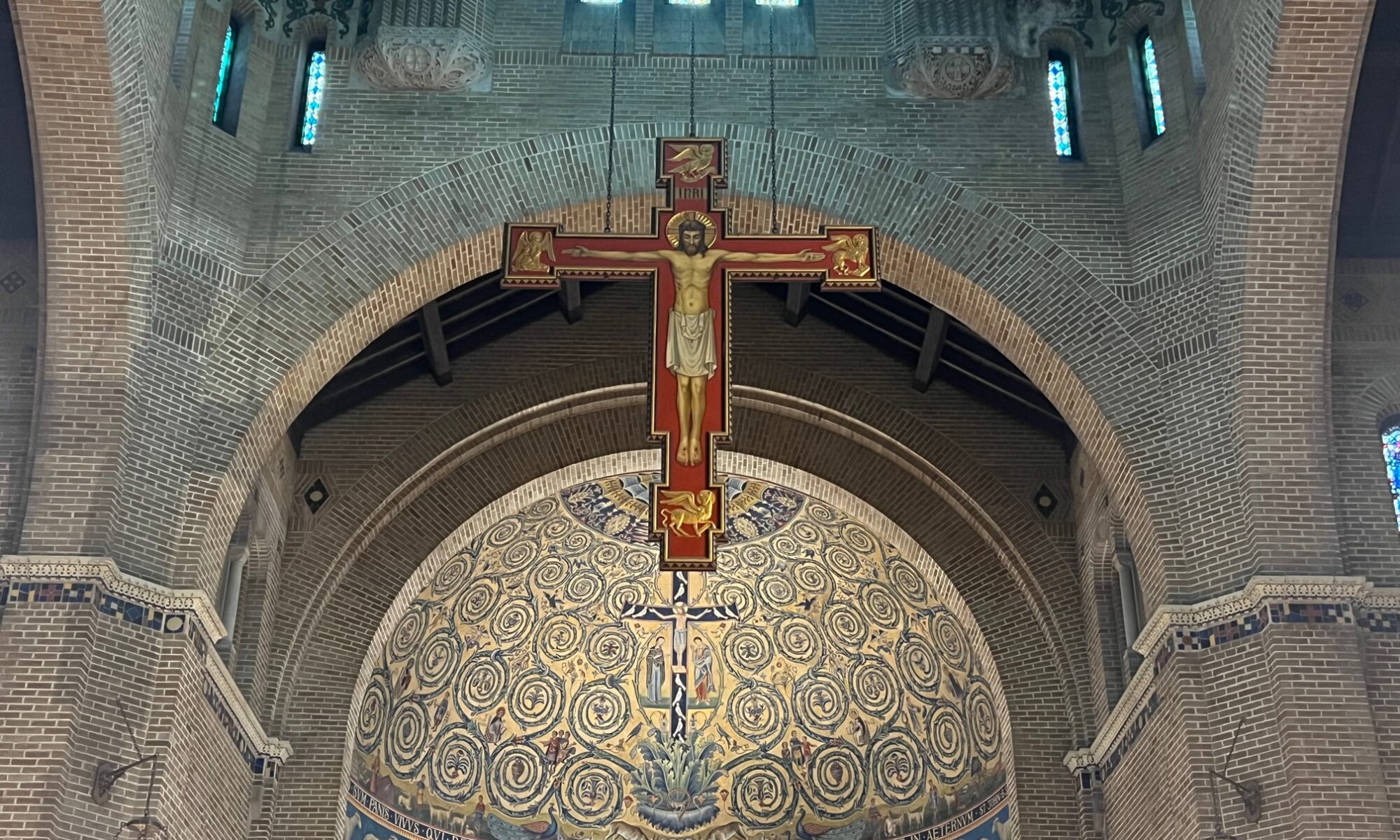
What does Jesus Christ give us at the Eucharistic banquet?

If the Eucharistic Prayer is the heart of the Mass, the words of consecration are the heart of the Eucharistic Prayer. The rest of the Mass is the sacred setting for this sacred moment.

Since the celebration of the Last Supper, the Church has faithfully maintained Jesus’ command: “Do this in memory of me” (Luke 22:19). Through the Eucharistic celebration, the Church makes present that moment, those gestures and words that Jesus made and pronounced. In that Supper, Christ instituted the Paschal sacrifice and banquet, by means of which the sacrifice of the cross is continually made present in the Church when the priest, representing Christ, pronounces the words of Jesus. At that moment, those same words that Jesus spoke, somehow, resonate again because of the priest’s sacramental representation of Christ.

“For Christ took the bread and the chalice and gave thanks; he broke the bread and gave it to his disciples, saying, “Take, eat, and drink: this is my Body; this is the cup of my Blood. Do this in memory of me.” Accordingly, the Church has arranged the entire celebration of the Liturgy of the Eucharist in parts corresponding to precisely these words and actions of Christ” (GIRM 72).

But we must ask ourselves: What did Jesus mean by those words of the Last Supper: “This is my body” (Luke 22:19)? The word body does not indicate in the Bible a part of man, which together with the other parts form the whole man. In biblical language, and therefore in the language of Jesus, “body” designates the whole man, man in his totality and unity. It designates man insofar as he lives his life in a body, in a corporeal and mortal condition. In the Gospel of John, instead of the word “body,” he uses the word “flesh” (John 6:54), and it is clear that this word found in chapter 6 has the same meaning as in chapter 1, where it says “the Word became flesh” (John 1:14), that is, man. “Body” thus indicates the whole of life. Jesus, in instituting the Eucharist, has left us as a gift his whole life, from the first moment of his Incarnation to his last breath.

Then he adds, “This is my blood” (Matthew 26:28). What does he add with his “blood”, if with his body he has already given us his whole life? He adds His death!

After giving us his life, he gives us the most precious part of it, his death. The term “blood” in the Bible does not indicate a part of the body. Rather, this term indicates an event: death. If blood is the seat of life, its shedding is the symbol of death. “Having loved his own who were in the world, he loved them to the end” (John 13:1). The Eucharist is the mystery of the Lord’s body and blood, that is, it is the mystery of the Lord’s life and death. It is in this way that each one of us is called to give our body with Jesus at Mass: be it time, health, energy, capacities, affections; and our blood: humiliations, failures, illnesses, everything that mortifies us. In this way we offer our bodies as a living, holy host, pleasing to God. (Romans 12:1)


López, Félix “Explanation of the Mass: The Consecration”, Home of the Mother, Accessed 15 April 2024, https://www.homeofthemother.org/en/resources/eucharist/549-explanation-of-the-mass/2418-consecration

How does the Eucharistic prayer unite us with the Universal Church?

The Second Vatican Council reminded us that in order to understand what the Church is, the concept we have to put at the center is communion. The Church is the People of God united in the same faith, with a communion that is a gift of God and a sign for the world.

The Eucharistic prayer is no stranger to this reality, and by celebrating what is most important to the Church, which is the Eucharist, it expresses that communion, and it does so on three levels.

First of all, it reminds us that we are in communion with all the Christian communities scattered throughout the world that are part of the Church, with whom we share the same faith when we celebrate the Eucharist. Our local community is not isolated from the rest of the Church. That is why we name the whole Church and the Pope in our prayers. We are also aware that our local Church is not only the assembly that has gathered to celebrate the Eucharist, and that is why we pray for the diocesan bishop, all the pastors who help him in his task, and all our brothers and sisters who share in the pilgrimage of faith on this earth. Thus, by celebrating the Eucharist, we are in communion with the Universal Church, which goes on pilgrimage to the Father’s house.

But we are also in communion with the deceased, who continue to belong to the ecclesial community, and that is why we remember them in the Eucharist, interceding for them. Communion is not broken by death, and in this way those who have already departed and may need the help of our prayer, by virtue of the communion of saints, are also recipients of our prayer. It is an expression of our communion with the deceased who are purifying their lack of love in the hope of enjoying the fullness of eternal life.

And we lack the third dimension of that communion: that which refers to the Church triumphant, to the saints. If what we do with the deceased is to intercede and ask the saints, who already enjoy the fullness of heaven, we ask them to intercede for us: the Virgin Mary in the first place, the apostles, the martyrs, all the saints… We are in communion with the blessed, we who walk in the hope of eternal beatitude.

And so, every day, in each of the celebrations of the Eucharist, we make communion with the Church. Not only enclosed in the small reality of our parish or our group, but open to the great richness of the mystery of communion that Christ wanted his Church to be, to bring his Word of life to the ends of the earth, until he returns.


Navarro, Ramón, “La Plegaria Eucarística, en el corazón de la celebración”, Diocese of Cartagena, Accessed 1 April 2024, https://diocesisdecartagena.org/formacion/la-plegaria-eucaristica-corazon-la-celebracion/

Why is the Eucharistic Prayer at the heart of the celebration of the Mass?

The Eucharistic Prayer is first and foremost that: a prayer, a prayer. It is located at the very center of the celebration, not because of chronology, but because of importance. It is a prayer that the celebrant proclaims, but in doing so he does so in the name of the whole assembly: it is not a personal or individual prayer of his own.

It is a prayer of thanksgiving, but it is also a prayer of consecration. In it the Holy Spirit is asked to transform the bread and wine into the Body and Blood of the Lord, and also to transform those who are to receive it, so that they may obtain a precious gift from God: unity, communion, being one body and one spirit.

In the Eucharist we find a moment of solemn petition of the Holy Spirit. In fact, there are two moments, and both are related to each other. Both are present in the Eucharistic Prayer.

Just before the consecration, the priest, by laying on his hands, invokes the gift of the Spirit upon the bread and wine. It is not a human action that transforms the gifts into the Body and Blood of Christ, but the action of the Spirit, which is solemnly invoked. It is God who saves, He is the one who transforms the bread and wine.

The Church wanted to highlight this double moment of epiclesis and consecration by asking us for a gesture of prayer and adoration, which is to kneel: from the moment the priest lays his hands on the offerings until the consecration of the chalice is over.

After the account of the institution, the priest again asks for the Spirit. This time he does not invoke it over the gifts, but on the assembly, on those who are going to receive those consecrated gifts. The Spirit transforms the bread and wine, and he also transforms the Christian community, “those of us who are going to partake of the Body and Blood of Christ.”

In the Eucharist we celebrate the memorial of Christ’s death and resurrection, and we do so with the signs He left us for this purpose at the Last Supper.

To celebrate this memorial is first and foremost to celebrate a presence in the “now” in which we live: the presence of Christ, of his salvation. Without repeating the events of our salvation, the grace that is poured out from them comes to us, because Christ is present in the liturgy of the Church. It is not a mere memory. It’s a presence; and an effective presence, which calls us to an encounter that changes our lives.


Navarro, Ramón, “La Plegaria Eucarística, en el corazón de la celebración”, Diócesis de Cartagena, Accessed 1 April 2024, https://diocesisdecartagena.org/formacion/la-plegaria-eucaristica-corazon-la-celebracion/

Why do we sing the Sanctus prior to the Eucharistic Prayer?

The “Holy” or Sanctus has been an integral part of the Eucharistic Prayer in both the East and the West since before the year 400. With it concludes the variable part of the prayer called the preface. Its text is composed of two sections, both inspired by Scripture and both conclude with the phrase, “Hosanna in the Highest”.

The juxtaposition of the two parts underscores two very different aspects of God. In the first part, the amazement and awe of the divine majesty stand out, and in the second, the humility of Jesus, God made man.

Holy is the very name of God, and more than a moral quality of God, it designates the very infinite quality of the divine being: He alone is the Holy One (Leviticus 11:44), and at the same time He is the only “source of all holiness” (Eucharistic Prayer II).

The first section of this prayer evokes the image of the transcendent God seated on his throne and the incessant liturgy that surrounds him, as described in the book of the prophet Isaiah (Isaiah 6:1-5) and in the book of Revelations (Revelation 4:2-8)

The second part of the Sanctus has its origin in Jesus’ triumphal entry into Jerusalem. The account describes the startling image of a humble God arriving in the Holy City on a donkey amid the acclamations of the people who rejoiced at the coming of salvation (Matthew 21:1-9).

The apparent contradiction in the portrayal of God in the two sections of the Sanctus is due to the prophetic nature of the first and the eschatological nature of the second. Jesus appears as the humble prophet who arrives in a city that will reject him and execute him. But he is also the spokesman for God who heralds the new time, and who tears the cosmos apart by destroying the distinction between the pure and the impure. He enters the Temple and drives out the coin changers who had turned God’s house into a den of bandits.

Let us join the heavenly choir by singing with praise the Sanctus during the celebration of the Eucharist, the sacramental memorial of the Lord’s Death, as Christian people let us proclaim to Jesus the same acclamations that the people addressed to him when he entered Jerusalem.


López, Félix “Explanation of the Mass – The Sanctus” Home of the Mother, accessed 19 March 2024 https://www.homeofthemother.org/en/resources/eucharist/549-explanation-of-the-mass/2413-the-sanctus

Why is the preface important in the Liturgy of the Eucharist?

“Eucharist” means “thanksgiving” and this thanksgiving is expressed very clearly in the Preface. In it, the priest, in the name of the holy people, glorifies God the Father and gives Him thanks for the work of salvation or for one of these aspects in particular. 

The preface consists of four parts:

  1. The initial dialogue, always the same, of very ancient origin, beginning with: “The Lord be with you…”, and ending with the response of the assembly “… it is right and just” that from the beginning binds the people to the priest’s prayer, and at the same time lifts up their hearts to God (Colossians 3:1-2).
  2. The elevation to the Father takes up the last words of the assembly, “it is right and just “, and with slight variations, raises the prayer of the Church to the heavenly Father. In this way the preface, and with it the whole Eucharistic prayer, addresses the prayer of the Church precisely to the Father. Thus, we do Christ’s will: “When you pray, say Father” (Luke 11:2).
  3. The central part, the most variable in its contents, depending on the different days and feasts, joyfully proclaims the fundamental motives of thanksgiving, which always revolve around creation and redemption.
  4. The end of the preface, which is a prologue to the Sanctus that follows, associates the Eucharistic prayer of the Church on earth with the worship of the heavenly liturgy, making the former an echo of the latter: “Therefore, with the angels and the saints, we proclaim your glory, by saying…”

The purpose of the preface is to thank and praise the greatness of God for all the gifts, all the benefits that throughout salvation history he has granted us, since this thanksgiving and praise are “right and just”.

Let us lift our hearts to the Lord not only as a ritual response, but as an expression of what is happening in this heart that rises and drags others upwards. Let us try to live always remembering the great benefits that the Lord has done for us.


López, Félix “Explanation of the Mass: The Preface”, Home of the Mother, Accessed 16 March 2024, https://www.homeofthemother.org/en/resources/eucharist/549-explanation-of-the-mass/2385-preface

What is the importance of the presentation of gifts?

The Liturgy of the Word and the Liturgy of the Eucharist are not two different acts of worship, but two moments of one same mystery. The Liturgy of the Eucharist begins with the preparation of the gifts.

 “The presentation of the offerings at the altar takes up the gesture of Melchizedek and commits the Creator’s gifts into the hands of Christ who, in His sacrifice, brings to perfection all human attempts to offer sacrifices.” (CCC 1350) It is a rite full of richness and expressiveness

This is the privileged moment for the collection, so that the faithful may offer their material assistance to their brothers in need. “From the very beginning Christians have brought, along with the bread and wine for the Eucharist, gifts to share with those in need. This custom of the collection (1 Corinthians 16:1), ever appropriate, is inspired by the example of Christ who became poor to make us rich” (2 Corinthians 8:9).

Pope Benedict XVI on his Apostolic Exhortation “Sacramentum caritatis” mentions how all of creation is taken up by Christ to be presented to the Father in the sacrifice of the Mass. In this moment, every man presents, with Christ, his sufferings, joys and work, which is considered as a collaboration in the creative work of God, according to the commandment of Genesis: “Fill the earth and subdue it.” (Genesis 1:28).

In the rite, the priest first takes the paten with the bread and, with both hands, slightly lifts it up over the altar, while saying the corresponding prayer. He does the same with the wine. The two almost identical prayers that the priest pronounces, out loud or quietly, are similar to those that Jesus used in his prayers of blessing, to which the assembly responds “Blessed be God forever” (Romans. 9:5; 2 Corinthians 11:31)

After presenting the bread and wine, the priest bows before the altar and prays quietly. In this way the priest prepares to celebrate the Eucharist “in spirit and in truth,” knowing that “a broken and contrite heart, O God, thou wilt not despise.” (Psalms 50)

The priest then washes his hands, thus obtaining his “interior purification.” Once at the altar again, he calls all present to prayer in order that our mutual sacrifice may be acceptable to God. And the assembly prays for the communal good and of the Church.

Let us remember that, along with the gifts, there is also the fruit of our sacrifice, that all human realities and all creation are included in the bread and wine, in all their simplicity. May the Lord our God accept our sacrifice for our good and all of His Holy Church.


López, Félix “Explanation of the Mass – The Preparation of the Gifts”, Home of the Mother, Accessed 10 March 2024, https://www.homeofthemother.org/en/resources/eucharist/549-explanation-of-the-mass/2435-preparation-of-the-gifts

What is the importance of the prayer of the faithful in Mass?

The Prayer of the Faithful is an important part of the mass, it is the moment when the congregation comes together as one to repeat their plea to the Lord, asking for his blessing for the Church and for the world. In this way, we answer the call of Saint Paul: “Do not be anxious about anything, but, in every situation, by prayer and petition, with thanksgiving, present your requests to God.” (Philippians 4:6).1

The Prayer of the Faithful is the intercession made by the baptized, at the proposal of the deacon or the lector, who indicates the intention for which to pray. That is to say, the reason for prayer is pointed out to all those present and then the faithful pray together for that intention: “Lord, listen and have mercy”, “We beg you, hear us”, “Lord, hear our prayer”. This is the prayer of the faithful because, in the first place, it is made by all the faithful – not by a reader – and, in the second place, because they address God directly. That answer of all is the true Prayer of the faithful.

Therefore, the Prayer of the Faithful is the prayerful response of the whole assembly to the Lord to an intention that the deacon or a lector proposes to everyone. Let us not confuse the terms: each of the requests that are pointed out is not the prayer of the faithful because they are simply monitions, indications; nor is it the prayer of the faithful, understanding that each request – sometimes in a language not of admonition, but directly addressed to God, not to the faithful – is made by a different reader. The Prayer of the Faithful is the common prayer that everyone makes: “Lord hear our prayer”2

The Prayer of the Faithful caps the Liturgy of the Word in a way similar to the reception of Holy Communion at the end of the Liturgy of the Eucharist. For in the Universal Prayer, the baptized exercise the very priesthood of Christ by mediating “for holy Church, for the civil authorities, for those oppressed by various needs, for all mankind, and for the salvation of the entire world” (Sacrosanctum Concilium 53).3

Let us pay attention during petitions, make them our own, and respond with our prayer, for our Lord Jesus Christ has told us that whatever we ask in His name will be fulfilled (John 14:13, Luke 18:1-7).


1 Anonymous, “Prayers of the Faithful” Hozana, Accesed on 2 March 2024, https://hozana.org/en/prayer/of-the-faithful

2 Sanchez Martínez, Javier “La Oración de los fieles (I)” Fundacion InfoCatólica – Liturgia, fuente y culmen, 7 March 2017, https://www.infocatolica.com/blog/liturgiafuenteyculmen.php/1703030114-la-oracion-de-los-fieles-i

3 Priest, Jeremy, “Is the Universal Prayer (Prayers of the Faithful or General Intercessions) required at every Mass?” Adoremus, 9 September 2019, https://adoremus.org/2019/09/q-is-the-universal-prayer-prayers-of-the-faithful-or-general-intercessions-required-at-every-mass/

Why do we say the Creed at every Sunday Mass?

The Creed serves as a personal profession of faith, which is why it begins with “I” rather than “We”, and is also called the “Symbol of Faith.”

We should also consider where the Creed is placed in the Mass. Why not begin our liturgy with the Creed to verify the communion of faith we are about to celebrate? Or profess it at the end to remind us of the faith we are to carry into the world? The Creed’s place immediately after the homily gives it particular significance.

The liturgy is a conversation between God and God’s people in which the priest serves as representative of both, and so speaks on behalf of both at different times. It is important to remember who is speaking and what is being proclaimed. In the biblical readings, God is speaking to the people. This conversation reaches a climax in the proclamation of the Gospel in which Jesus is proclaimed as the Word of God incarnate who now speaks to his body, the Church. For this reason, we stand for the Gospel and show other appropriate signs of reverence.

Following the Gospel, the priest or deacon proclaims the homily which continues the Word of God as it is applied to our daily lives, leading us more deeply into the Paschal Mystery we are called to live and the memorial of which we are about to celebrate in the Eucharist.

The Profession of Faith is our opportunity as God’s people to respond to the Lord’s self-revelation and salvation. The word of God must be understood and accepted, lest we be passive spectators rather than active listeners (James 1:22).

The Creed is how we say to God: We have heard you and we believe you! The Creed is a summary of Scripture. It expresses our faith in God who is a Trinity of Persons that has acted in historical events and is revealed definitively in the person of Jesus. This revelation continues to mature and grow through the Holy Spirit present in the Church. We are proclaiming that we believe all this revelation, not just part of it, and that God offers it to us as an effective testament of his saving and redeeming love for us.

The next time we profess the Creed at Mass, let us remember to whom we are speaking. Think about what God has just said to us in the Scriptures and in the homily. Reflect on what it means to be a member of Christ’s people accepting the fullness of what God has revealed and eager to witness Christ to the world.


Mueggenborg, Daniel “Why do we say the Creed at every Sunday Mass?”, Northwest Catholic, 27 August 2021, https://nwcatholic.org/voices/daniel-mueggenborg/why-do-we-say-the-creed-at-every-sunday-mass

What is the importance of the readings during Mass?

After the “Gloria” has been sung or recited, the priest invites the assembly to pray. Then the priest says the “collect” prayer and by which the character of the celebration is expressed. The collect prayer is usually addressed to God the Father, through Christ, in the Holy Spirit, and is concluded with a trinitarian ending. The people, uniting themselves to this entreaty, make the prayer their own with the acclamation, Amen. (GIRM 54)

The Collect the introductory rites of the Mass conclude and then proceeds to the Liturgy of the Word.

The Liturgy of the Word is to be celebrated in such a way as to promote meditation, and so any sort of haste that hinders recollection must clearly be avoided. It is also appropriate to include brief periods of silence, in which, at the prompting of the Holy Spirit, the word of God may be grasped by the heart. It may be appropriate to observe such periods of silence, before the Liturgy of the Word itself begins, after the first and second reading, and lastly at the conclusion of the homily (GIRM 56).

In the readings, the table of God’s word is prepared for the faithful, and the riches of the Bible are opened to them. Hence, it is preferable to maintain the arrangement of the biblical readings, by which light is shed on the unity of both Testaments and of salvation history. Moreover, it is unlawful to substitute other, non-biblical texts for the readings and responsorial Psalm, which contain the word of God (GIRM 57).

The function of proclaiming the readings is ministerial, not presidential. The readings, therefore, should be proclaimed by a lector; On the other hand, the deacon, or in his absence, the priest, will proclaim the Gospel (GIRM 59).

After the first reading comes the responsorial Psalm, which is an integral part of the Liturgy of the Word and holds great liturgical and pastoral importance, because it fosters meditation on the word of God.  It is preferable that the responsorial Psalm be sung, at least as far as the people’s response is concerned. Hence, the psalmist, or the cantor of the Psalm, sings the verses of the Psalm from the ambo or another suitable place (GIRM 61).

After the reading that immediately precedes the Gospel, the Alleluia or another chant indicated by the rubrics is sung, as required by the liturgical season The Alleluia is sung in every season other than Lent (GIRM 62).

The homily is part of the Liturgy for it is necessary for the nurturing of the Christian life (GIRM 65). The homily should ordinarily be given by the priest celebrant himself, He may entrust it, according to circumstances, to the deacon, but never to a lay person (GIRM 66).

Let us listen attentively to the readings and the Gospel that are the living word of God and nourishment of our spirit, let us also listen attentively to the homily which calls us to reflect on the Scriptures and their application to our lives.

Why are the Mass Introductory Rites important?

When the entrance procession is over, and the priest and the deacon have been venerated at the altar, and after incensing it in the case of solemn celebrations, the priest goes to his chair and, together with the whole assembly, makes the sign of the cross, while saying: “In the name of the Father, of the Son, and of the Holy Spirit,” to which the assembly responds “Amen,” thus acknowledging that God is one expressed in the Holy Trinity.

The priest then salutes the assembly, which can be given in its short version: “The Lord be with you” or in its longer form: “The grace of our Lord Jesus Christ, and the love of the Father and the communion of the Holy Spirit be with you all.”, (Roman Missal 2), the response of the assembly being “And with your spirit”. It is through this greeting and the response of the assembly that the mystery of the Church gathered together is made manifest (GIRM 50)

The priest then invites those present to take part in the Act of Penitence which, after a brief pause of silence, is carried out by means of the formula of the general confession of the whole community, and concludes with the absolution of the priest which, however, lacks the efficacy of the sacrament of Penance (GIRM 51). Which means, this absolution is only for those venial sins of which we are truly repentant, for in order to be absolved of mortal sins we must attend the Sacrament of Reconciliation or Penance.

Once the Act of Penitence is over, it is always followed by the “Lord, have mercy…”  where, after having confessed ourselves to be sinners, we ask for the mercy of our Lord, so that he may accept our sacrifice and find us worthy to receive him in communion.

The introductory rites conclude with the “Gloria” in which we join the angels of heaven in proclaiming the immeasurable glory of God, we ask our Lord Jesus Christ to hear us and have mercy on us, since He is the one who takes away the sin of the world. It should be noted that at the mention of our Lord’s name we bow, not only following the norms of the Church (GIRM 275), but also the scriptures (Philippians 2:9-11). The singing or recitation of the Gloria is suspended during the liturgical seasons of preparation, Lent and Advent.

Let us participate attentively in the introductory rites of the Mass, for they not only prepare us to be nourished by the Word of God and the Body and Blood of our Lord, but they work for the purification of our soul and prepare us to be one with Jesus Christ.