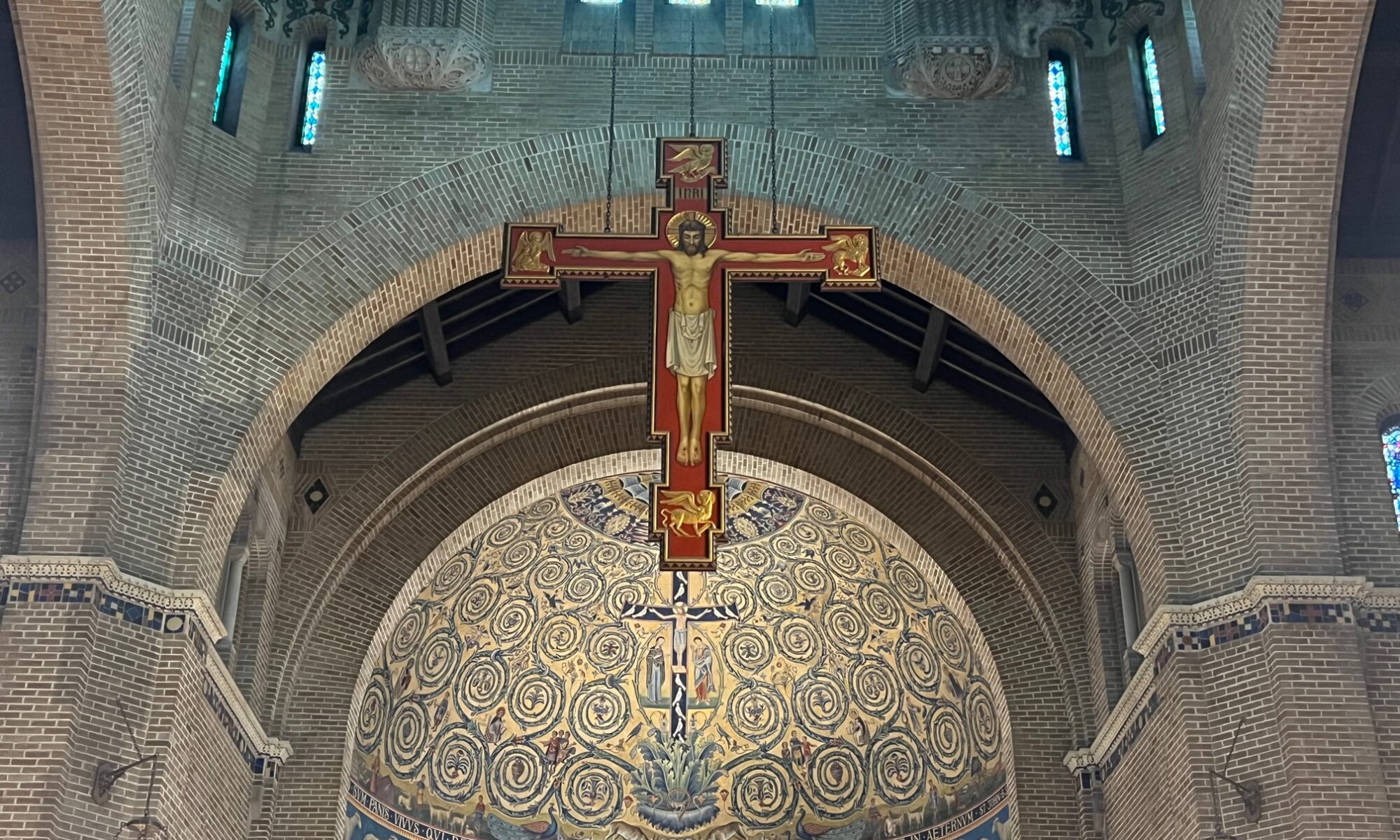
Why do we make the sign of the Cross?

Before each prayer we make the sign of the Cross, but why do we do it? The sign of the cross comes from the first centuries of Christianity, since we find in the writings of Tertullian, who lived between the years 160 and 220 AD, the following: “In all our travels and movements, in all our departures and arrivals, When we put on our shoes, when we take a bath, at the table, when we light our candles, when we go to bed, when we sit down, in any of the tasks in which we occupy ourselves, we mark our foreheads with the sign of the cross.”, the first Christians justified this sign according to the book of Revelation where it is indicated that the servants of God will have a seal on their foreheads (Revelation 7:3, 9:4, 14:1).

This sign on the forehead later evolved into the sign of the cross that we know today, from the forehead to the chest, indicating that Jesus Christ descended from heaven to earth in his Incarnation, and from the left shoulder to the right, indicating that after his death He descended into hell and ascended to Heaven, where he is seated at the right hand of the Father.

It is during the sign of the cross that we say the words: “In the name of the Father, and of the Son, and of the Holy Spirit”, thus certifying that the name of God is one and that God is expressed in the three persons of the Holy Trinity. It is also by pronouncing these words that we express our baptismal legacy, where we die to sin and rise in Christ. By making the sign of the cross we are witnessing with body and soul our faith, we mark the cross in ourselves, thus claiming to ourselves the Cross of Christ and His victory over sin through His sacrifice.

Let’s be aware of everything we express when we make the sign of the cross and say the words that accompany it. Let us always be witnesses and proclaim our faith before the world, that our Lord Jesus Christ died on the cross for the atonement of our sins and by His sacrifice and resurrection we have been saved.

What do we celebrate on Candlemas?

On February 2, the Church traditionally celebrates Candlemas, but how does this celebration come about? According to the law (Leviticus 12:1-4), a woman could not touch anything consecrated to God or enter the temple until 40 days after giving birth, this feast of the purification of Mary and the presentation of Jesus to the temple (Luke 2:22-23) occurs for this reason 40 days after Christmas. Jesus was not only presented to the temple but also consecrated to God, according to the law (Exodus 13:2).

On Candlemas, the Catholic faithful will take home candles that have been blessed, these candles will symbolize Jesus Christ, the wax being a symbol of his pure body, the wick the symbol of his soul, and the flame symbol of his divinity.

This candle, every time it is lit in your home, will remind us that Jesus Christ is the Light of the world, that all those who follow him will have the light that gives life and will not walk in darkness (John 8:12).

It is following this sacred tradition that we bring our children shortly after they are born to present them to our Lord, and then consecrate them to God through baptism.

Sacred Tradition and Sacred Scripture, are bound closely together, and communicate one with the other. For both of them, flowing out from the same divine well-spring, come together in some fashion to form one thing, and move towards the same goal.” Each of them makes present and fruitful in the Church the mystery of Christ, who promised to remain with his own “always, to the close of the age” (CCC 80)

Let us be part of the Church’s tradition, which is a living transmission, carried out by the Holy Spirit, which, although it is different from Holy Scripture, is closely connected to it. Through it, the Church in her doctrine, life and worship, perpetuates and transmits to every generation all that she herself is, all that she believes (CCC 78).

What is catechism?

Many times we have heard about catechism, we are even aware that we must take our children to catechism so that they know their faith. But, what is catechesis and how was it born? Catechesis is a mandate from Jesus Christ to his Apostles (Matthew 28:19-20). This treasure, received from the Apostles, has been faithfully guarded by their successors. All Christ’s faithful are called to hand it on from generation to generation, by professing the faith, by living it in fraternal sharing, and by celebrating it in liturgy and prayer (CCC 3).

The Church has always considered catechesis one of her primary tasks. Jesus Christ entrusted his apostles with the mission and power to proclaim to humanity what they had heard, what they had seen with their eyes, what they had looked upon and touched with their hands, concerning the Word of Life. He also entrusted them with the mission and power to explain with authority what He had taught them, His words and actions, His signs and commandments. And He gave them the Holy Spirit to fulfill this mission.

Very soon the name of catechesis was given to the whole of the efforts within the Church to make disciples, to help people to believe that Jesus is the Son of God, so that believing they might have life in His name, and to educate and instruct them in this life and thus build up the Body of Christ. The Church has not ceased to devote her energy to this task (Catechesi Tradedae 1).

Catechesis is an education in the faith of children, young people and adults which includes especially the teaching of Christian doctrine imparted, generally speaking, in an organic and systematic way, with a view to initiating the hearers into the fullness of Christian life (CCC 5).

Catechesis also means the intention to transmit not one’s own teaching or that of some other master, but the teaching of Jesus Christ, the Truth that He communicates or, to put it more precisely, the Truth that He is. We must therefore say that in catechesis it is Christ, the Incarnate Word and Son of God, who is taught – everything else is taught with reference to Him – and it is Christ alone who teaches – anyone else teaches to the extent that he is Christ’s spokesman, enabling Christ to teach with his lips. Whatever be the level of his responsibility in the Church, every catechist must constantly endeavor to transmit by his teaching and behavior the teaching and life of Jesus (CT 6).

Let us also follow the mandate of Jesus Christ, let us be the first catechists for our children, let us catechize our friends and family with our example of life following the teachings of our Lord Jesus Christ and let us be receptive to continue being catechized always.

When should I receive the anointing of the sick?

The Sacrament of Anointing of the Sick, often referred to as Extreme Unction or Last Rites, is a ritual of healing appropriate not only for those in immediate danger of death but also for those suffering from physical, mental, or spiritual sickness. Jesus Christ establishes this sacrament through his ministry healing the sick, and entrusting His disciples that they also do it (Mark 6:12-13).

This is not a sacrament for those only who are at the point of death. Hence, as soon as anyone of the faithful begins to be in danger of death from sickness or old age, the fitting time for him to receive this sacrament has certainly already arrived (CCC 1514).  If a sick person who received this anointing recovers his health, he can in the case grave illness receive this sacrament again. It is fitting to receive the Anointing of the Sick just prior to a serious operation. The same holds for the elderly whose frailty becomes more pronounced (CCC 1515).

Like all the sacraments the Anointing of the Sick is a liturgical and communal celebration, whether it takes place in the family home, a hospital or church, for a single sick person or a whole group of sick persons. It is very fitting to celebrate it within the Eucharist, the memorial of the Lord’s Passover. If circumstances suggest it, the celebration of the sacrament can be preceded by the sacrament of Penance and followed by the sacrament of the Eucharist. As the sacrament of Christ’s Passover the Eucharist should always be the last sacrament of the earthly journey, the “viaticum” for “passing over” to eternal life (CCC 1517).

The celebration of the sacrament includes the following principal elements: the “priests of the Church” —in silence— lay hands on the sick; they pray over them in the faith of the Church (James 5:14-15), this is the epiclesis proper to this sacrament; they then anoint them with oil blessed, if possible, by the bishop. These liturgical actions indicate what grace this sacrament confers upon the sick (CCC 1519).

The first grace of this sacrament is one of strengthening, peace and courage to overcome the difficulties that go with the condition of serious illness or the frailty of old age. This grace is a gift of the Holy Spirit, who renews trust and faith in God and strengthens against the temptations of the evil one, the temptation to discouragement and anguish in the face of death (Hebrews 2:15). This assistance from the Lord by the power of his Spirit is meant to lead the sick person to healing of the soul, but also of the body if such is God’s will. Furthermore, “if he has committed sins, he will be forgiven.” (CCC 1520).

Let us go without fear to receive this sacrament when we are sick, or already advanced in age, let us entrust ourselves to our Lord Jesus Christ before any major surgery and let us unite ourselves with the suffering and glorified Lord to relieve us and save us, let us surrender our suffering to join the Passion and Death of Christ; and thus contribute to the good of the People of God (CCC 1499)

And you, who do you say that I am?

While Jesus was in his ministry, in the region of Caesarea Philippi, after having fed more than four thousand men, he asked his disciples the following question, “Who do people say that the Son of man is?” (Matthew 16:13), and they reply “Some say John the Baptist; others say Elijah; and still others, Jeremiah or one of the prophets.” (Matthew 16:14), then he asks them the same question: “And you, who do you say I am?”, to which Simon Peter, answers him: “You are the Messiah, the Son of the living God” (Matthew 16:15-16), Jesus blesses Simon saying: “Blessed are you, Simon son of Jonah, for this was not revealed to you by flesh and blood, but by my Father in heaven” (Matthew 16:17), to then establish on him the foundations of the Church, giving him power over earthly things (Matthew 16:18-19).

It is important to note the point of view of the people at that time, according to the testimony of the apostles, the people still resisted recognizing Jesus as the Messiah despite the miracles he was already performing among them, but compared Him to something they already knew, with John the Baptist or as one of the prophets, since they had a preconception of how the Messiah was to arrive. Being oppressed by dominance Roman, they expected a liberator of a military nature, a strongman; without realizing that the greatest oppressor of humanity is sin. It is at that moment that God reveals to Simon  Peter through the Holy Spirit the reality of who his teacher was, the promised Messiah, Son of the Living God. It is after this episode that Jesus will reveal to three of his disciples: Peter, James and John, his divine nature (Matthew 17:1-2).

Do we recognize Jesus Christ as the Son of God, the Lamb of God who takes away the sin of the world? (John 1:29) Have we paid attention when he said that whoever does not eat of his body and drink of his blood will not partake of eternal life? (John 6:53-55)

What would our response be, if walking the path of our life, we met Jesus Christ, and looking into our eyes he asked us: and you, who do you say that I am?

What is Epiphany?

We know as Epiphany the divine manifestation of Jesus Christ, the first of these being the wise men from the East. But this fact has a much greater meaning, it is the manifestation of the Son of God to the Gentiles, to the people who were not Jews, in other words, to all of us. This manifestation not only happens when they finally find baby Jesus, but even before starting their journey, since these wise men arrived in Jerusalem because they had seen His star rise (Matthew 2:1-2), that is, even before they had him in front of them, the light of Jesus Christ (John 8:12) had already been revealed to them.

When the wise men reached Bethlehem, following the star again, it stopped over the place where Jesus was (Matthew 2:9-10). They entered the abode and paid homage to him by offering him gifts (Matthew 2:11): gold signifying his royalty as a son of the Most High, a descendant of the line of David (Isaiah 11:10); frankincense, used as an ingredient in the incense that was burned as an offering in front of the ark of the covenant (Exodus 30:34-37), recognizing him as high priest and also as God’s new covenant with the world; and myrrh, a perfume that was an ingredient in the sacred oil used to anoint high priests and kings, again acknowledging his role as high priest and king of kings.

They left us a great teaching: Jesus Christ from his birth was destined to be the salvation of the world, we are all now the new chosen people of God (1 Peter 2:10), and called to be his children because we enter into communion with Jesus Christ through of the Holy Eucharist.

Just as the wise men from the East recognized in Jesus Christ the promised Messiah, God’s new covenant with the whole world, let us also recognize the body and blood of Jesus in the consecrated bread and wine, source of eternal life, which was offered in sacrifice for the forgiveness of our sins and thus we can achieve salvation.

What should I call the Virgin Mary?

The Virgin of the Pillar, the Virgin of the Snow, the Virgin of the Rosary, the Virgin of Mount Carmel, the Virgin of Candelaria, the Virgin of El Pino, the Virgin of Guadalupe, the Virgin of Coromoto, the Virgin of Lourdes, the Virgin of Fatima, how many virgins are there? Virgin Mary there is only one, the mother of God, all those named are the different dedications that are given to the only Virgin Mary, spiritual mother of humanity.

The Virgin Mary has few words recorded in the gospels, but within the few that she has, she has left us profound teachings, after asking the angel sent by God how the miracle of the conception of the Son of God could occur, the following thing she tells us shows her faith, humility and total surrender to the Lord: “Behold, the handmaid of the Lord, be it unto me according to thy word” (Luke 1:34-38), Mary begins from that moment his ministry of helping those in need, promptly going to the care of his cousin Elizabeth, who in her old age was pregnant by the work of the Lord, it is once in Elizabeth where we heard for the first time the recognition of her great role, “blessed are thou among all women, and blessed is the fruit of thy womb” (Luke 1:41-42).

It is also where her cousin Elizabeth gives us a beautiful teaching of faith in God through the Magnificat or Canticle of Mary (Luke 1:46-55) this is a powerful prayer, it shows the great faith and hope of the Virgin Mary, the Magnificat speaks to us even today, to those parents without resources, to those who do not have food on the table, to the elderly who are abandoned, to the dispossessed. All of them are present in the hope that the Virgin Mary proclaims.

Mary, being our heavenly mother, like every mother, cares for each and every one of us as a mother cares for all her children, even the most disobedient; That is why, through his multiple appearances, he has helped us to deepen our faith, almost as if repeating the words he pronounced at the wedding in Cana “Do whatever He tells you” (John 2:4-5).

Let us recognize the Virgin Mary as the mother of God and as our heavenly mother every time we pray the Hail Mary, and let us obey her as children so that we can hear the call of Jesus Christ, and do what He tells us.

What do we really celebrate at Christmas?

Nativity scenes, decorated trees, lights, garlands, gifts, special dinners; All this makes Christmas present to us, a time in which joy abounds, but within that joy, what is it that we really celebrate at Christmas? Do we celebrate the secular vision of a good-natured and generous bishop riding around in a reindeer-drawn sleigh? Do we celebrate in advance the gifts brought by the wise men from the east or also known as the Three Kings? Or is it that we celebrate the first coming of the world’s redeemer and prepare for his second coming?

The first coming of Jesus Christ into the world is that coming prophesied from the beginning of time (Genesis 3:15) to save humanity from sin, because God so loved the world that he gave his only Son, so that everyone who believes in Him would not die, but have eternal life (John 3:16). Our Lord Jesus had to come to this world as a man, because, just as Adam’s  trespass resulted in condemnation for all people, so also one righteous act of Jesus Christ resulted in justification and life for all people (Romans 5:18-19).

Jesus in his ministry lets us glimpse through many of his parables that we must be prepared for his second coming. Advent season gives us an example of how we can prepare ourselves. During advent we prepare the nativity scene, cleaning the dust accumulated in each figurine from being stored for almost a year, we make a space in our home to assemble it and make it look beautiful, and then we keep the manger empty to place the baby Jesus in it in the last hours on Christmas Eve, so we must also prepare ourselves to receive Jesus, cleansing our souls of those sins that we may have committed, making space for mercy in our hearts, and just as the manger receives Jesus, let us also receive his body that it is the bread of eternal life (John 6:35) every time we come to Mass.

Let us celebrate Christmas always, with the perfect banquet, the banquet that Jesus Christ himself has prepared for us, the banquet that gives us eternal life consecrated on the altar, so that the grace, love and peace of our Lord Jesus Christ may always be with us.

What is the Incarnation?

During the last week of Advent, the Church guides us to meditate on the mystery of the Incarnation, but what is the Incarnation itself? As the apostle Saint John says in the preface of his gospel: “In the beginning was the Word, and the Word was with God, and the Word was God…  The Word became flesh and made his dwelling among us…” (John 1:1,14) The incarnation means that the second Person of the Trinity, the eternal Son of God became flesh, in other words, he assumed a nature additional to the divine, a human nature.

But this miracle would not be possible without the acceptance of Mary, the human vehicle through which Jesus Christ became incarnate and dwelt among us, the one through whom we were created (John 1:3) wanted to be part of human nature and was the Holy Spirit was incarnate of a virgin as Isaiah had prophesied (Isaiah 7:14), Jesus Christ is born, God and man at the same time. Faced with the angel Gabriel’s announcement that she would be the mother of the promised Messiah, Mary humbly accepts by saying: “I am the Lord’s servant. May your word to me be fulfilled.” (Luke 1:34-38)

The incarnation is also necessary for the redemption of sins, it was necessary for Jesus Christ to take human form, since it was necessary for him to be born under the law (Galatians 4:4-5), to fulfill the law in our favor (Matthew 5:17). It was also necessary that our Savior shed his blood for the forgiveness of sins (Hebrews 9:22), since without a body of flesh and blood there can be no blood sacrifice. Without the Incarnation, our Lord Jesus Christ could not really die, and the cross would have no meaning.

Let us participate in the great banquet that our Lord Jesus Christ has prepared for us, since it is through his sacrifice of his flesh and blood that we were redeemed from sin, flesh and blood that are present in the consecrated bread and wine.

Is it all penance during the Advent season?

During the liturgical season of Advent, as Catholics we prepare our hearts for the second coming of our Lord Jesus Christ, doing penance for our sins and being austere to avoid falling into temptation that will take us away from that eternal dwelling that the Lord has reserved for us in heaven. (John 14:2), but neither should we fall into a gloomy mentality, because the Lord will come victorious and full of glory to reign over Heaven and Earth (CCC 1043), and His kingdom will have no end (Luke 1:32-33).

That is why our Holy mother Church teaches us that we must also rejoice during this time of preparation, through “Gaudete” Sunday, the third Sunday during Advent, this is a Sunday of rejoicing, because the Lord is at hand. Let us be filled with joy because we will overcome sin and eternal death through Jesus Christ, King of the universe and redeemer of the world.

Let us joyfully participate in the banquet with which Jesus Christ offers us eternal life (John 6:58). Let us do good works for the benefit of our brothers in Christ, and thus bear good fruit in the eyes of God (Matthew 7:15-20). Let us keep the Bible as a source of continuous reference and let us participate in the joy of the gospel (Evangelii Gaudium 5).

Let us rejoice in the Lord always. Let our gentleness be evident to all. Let us not be anxious about anything, but in every situation  by prayer and petition, with thanksgiving, present your requests to God (Philippians 4:4-6).